

Introduction
Indonesia is a group of islands off the coast of Southeast Asia which is home to a population of 281 million, scattered across more than 17,000 islands throughout the archipelago. With over 700 languages spoken, it is the second-most linguistically diverse country in the world. Bahasa Indonesia is the official national language, spoken by over 90% of the population. The majority religion in Indonesia is Islam, with over 87% of the total population being Muslim – making it the largest Muslim population in the world.1
Islam was introduced to Indonesia around the 13th century through trade, not conquest. Muslim traders from the Middle East, India, and later China brought the religion to major port cities such as Aceh and along the northern coasts of Java and Sumatra. Over time, local rulers and communities converted to Islam, blending Islamic teachings with existing cultural traditions. By the 15th and 16th centuries, Islam had become the dominant religion in many parts of the archipelago. 2
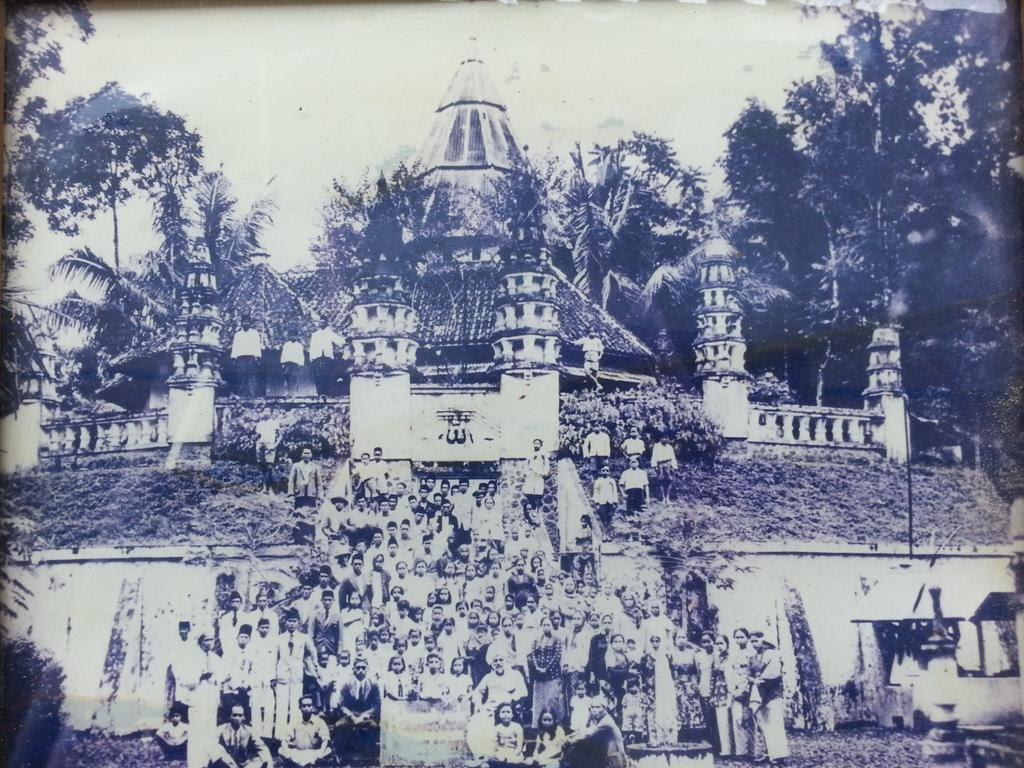
In 1925, Indonesia was still under Dutch colonial rule, and Islam was already the majority religion. This was also the year when Ahmadiyya began to take root in the land of Indonesia.
Jama’at Ahmadiyya Indonesia
Jama’at Ahmadiyya Indonesia has more than 500 thousand members with more than 500 branches in Indonesia.3 The present Amir of the Indonesian Jama’at Ahmadiyya is Mirajudin Shahid. The previous Amir before him was Maulana Abdul Basit Shahid. Both are graduates from Jamia Ahmadiyya Rabwah, Pakistan. Ahmadiyya missions exist in every province from Sumat (may Allah be pleased with him) to Papua.
Three pioneers of Ahmadiyyat in Indonesia
Many non-Ahmadi Muslims in Indonesia say that Ahmadis are not Muslims. They believe that Ahmadis lack a strong Islamic education and are not qualified Islamic scholars. They also think Ahmadis don’t know much about Islamic literature. However, this perception is completely incorrect.
Ahmadiyyat was introduced to Indonesia by three senior students from Islamic seminaries. The same schools have produced many respected Islamic scholars in the country. They follow a traditional Islamic education system, like that of many seminaries in Pakistan and India. The graduates of these institutions become Indonesian Islamic scholars—known as ulama in the Arabic language.
The three senior students were Maulana Abubakar Ayyub, Maulana Ahmad Nuruddin, and Maulana Zaini Dahlan, all from West Sumatra. Maulana Abubakar Ayyub and Maulana Ahmad Nuruddin were senior students from the well-known Islamic seminary Sumate Thawalib while Maulana Zaini Dahlan was a senior student of Madrasah Darun Nabwah.

One day, they wanted to study abroad, and they considered travelling to Egypt, which had long been recognized as a hub of International Islamic studies. However, their teacher at Sumate Thawalib, Maulana Zainuddin Labay, encouraged them to head to India instead, as it was emerging as a new center for modern Islamic thought. In December 1922, Maulana Abubakar Ayyub and Maulana Ahmad Nuruddin left their homeland to continue their religious education, while Maulana Zaini Dahlan experienced obstacles which prevented him from leaving at the same time and so he left later.4 The three eventually reunited in Lucknow, India. At that time, none of them could have foreseen that their journey— which was guided by divine will—would become a pivotal moment in the history of Islam in the Indonesian archipelago, particularly in the growth of the Ahmadiyya movement.5

After they reached Lucknow, they had the chance to study in Madrasah Darun Nadwah. However, they were not satisfied with their studies, and they decided to move to Lahore. In Lahore, they met with Maulana Abdussatar Sahib, who taught them and introduced them to the Ahmadiyya movement and its teachings. They were impressed by his message, especially his comprehensive explanation regarding the death of Hazrat Isa (peace be upon him). Finally, Maulana Abdussatar Sahib suggested them to visit Qadian.6
Visit to Qadian
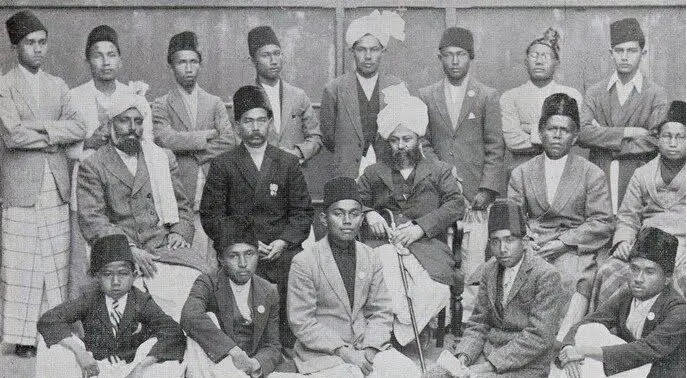
By the grace of Allah, the three of them had the chance to meet Hazrat Musleh Mau’ud (may Allah be pleased with him), the second Caliph of the Ahmadiyya Jama’at, and they took the Bai’at pledge immediately. They were very satisfied with their studies in Qadian and sent letters to Indonesia encouraging their friends to come to Qadian. Afterwards, a total of 12 people from Indonesia arrived in Qadian. Their names were: Hajji Mahmood, Mohammad Nur, Abdul Qoyyum, Muhammad Samin, Samsuddin Rao-rao, Samsuddin, Mohammad Jusak, Mohammad Ilyas, Hajji udin, Abdul Azis Shareef, Mohammad Idris, and Abdul Samik.7
Invitation to visit Indonesia
In July 1924, Hazrat Khalifatul Masih II Mirza Bashiruddin Mahmud Ahmad (may Allah be pleased with him) travelled to the Middle east and United Kingdom and came back in November 1924. After his arrival, the Indonesian students in Qadian invited him to a tea party meeting. This was a common tradition at that time in Qadian. During the meeting, the Indonesian students humbly invited Huzoor (may Allah be pleased with him) to visit Indonesia. Huzoor (may Allah be pleased with him) charmed the students and said that the Jama’at will certainly pay attention to the invitation, but he may not be able to visit Indonesia personally. However, Huzoor (may Allah be pleased with him) promised to appoint one of his representatives to go in his stead. Huzoor (may Allah be pleased with him) appointed Maulana Rahmat Ali (may Allah be pleased with him) as the first missionary in Indonesia.8
Hazrat Maulana Rahmat Ali (may Allah be pleased with him)

Hazrat Maulana Rahmat Ali (may Allah be pleased with him) was born in 1893. His father, Hazrat Muhammad Hassan (may Allah be pleased with him) was very passionate to devote his son for the service for the Jama’at. Maulana Rahmat Ali (may Allah be pleased with him) is one of the first generation of students who graduated from Madrasa-e-Ahmadiyya Qadian in 1917. He became an Arabic and religious teacher at Ta’limul Islam High School in Qadian and was later transferred to the tabligh department in 1924. He was appointed as Ahmadiyya first Missionary to Indonesia and served from 1925-1950. On August 31st, 1958, he passed away and was buried in Rabwah, Pakistan.9
First Ahmadiyya Missionary to Indonesia
In August 1924, Hazrat Khalifatul Masih II, Mirza Bashiruddin Mahmood Ahmad (may Allah be pleased with him) appointed Maulana Rahmat Ali (may Allah be pleased with him) as the first missionary to Indonesia. On August 15th, 1925, there was an official ceremonial for the appointment of Maulana Rahmat Ali and the main message from Huzoor (may Allah be pleased with him) was:
“We should always pray to God in every situation.”
On August 17th, 1925, Maulana Rahmat Ali (may Allah be pleased with him) departed from Qadian to Batala and continued his journey to Calcutta and from there set sail to Indonesia. He arrived in the northern part of Sumatra, Indonesia on the 2nd of October 1925. In Indonesia, Maulana Rahmat Ali (may Allah be pleased with him) was welcomed by the friends and relatives of the Indonesian students who studied in Qadian. He then established the first Ahmadiyya Jama’at with around 13 followers. In 1926, he travelled to West Sumatra, where he established the second mission.10 He continued to travel to the eastern part of Indonesia and in 1931, finally arrived in Jakarta. In December 1935, the first National Ahmadiyya Conference was held in Jakarta, and the first National Organization Committee was founded. Raden Muhyiddin was elected as the first president of Jama’at Muslim Ahmadiyya in Indonesia. At that time, the organization’s name was the Indonesia Department of Ahmadiyya Qadian. In June 1937, the name changed to become the Anjuman Ahmadiyya Department of Indonesia. At the end of 1949, the name changed to Jama’at Ahmadiyya Indonesia which has been the official name of the community until now.
The Ahmadiyya Jama’at in Indonesia has become an integrated part of Jama’at Ahmadiyya Muslim Worldwide which flourishes under the leadership of Khilafat. Jama’at Ahmadiyya Indonesia is continuously growing despite facing opposition in certain areas. The Indonesian Jama’at also gains more support day by day from many Muslim intellectuals and from university youth students who are invited to visit and stay in our centers for a couple of days.11
May Allah the Almighty reward the pioneering members of the Indonesian Jama’at for their relentless services and enable the Jama’at to continue to grow and progress under the guidance of Hazrat Khalifatul Masih V (may Allah be his Helper), Ameen!

References:
- https://www.originaltravel.co.uk/travel-guide/indonesia/fun-facts
- Johns, Anthony H. (1975). “Islam in Southeast Asia: Reflections and New Directions.” Indonesia, no. 19, pp. 33–55.
- Indonesia:Domestic Politics,strategic dynamics,and American Interests (Page 20)
- https://ahmadiyah.id/sejarah-ahmadiyah-indonesia.html
- Ibid
- Ibid
- Ibid
- Ibid
- https://www.ahmadipedia.org/content/personality/324/hazrat-maulvi-rahmat-ali-(ra)
- https://ahmadiyah.id/sejarah-ahmadiyah-indonesia.html
- https://en.wikipedia.org/wiki/Ahmadiyya_in_Indonesia